2025 Oʻahu Weed Control and Restoration Workshop
Priority ONE (Oʻahu Native Ecosystems) Working Group
Presentations, restoration breakout discussions, and an herbicide trial design activity — with slides, audience questions, posters, and the worksheet.
Waiʻanae Mountains Watershed Partnership · DOFAW Native Ecosystem Protection and Management · Kualoa Ranch · Army Natural Resources Program Oʻahu · Ecosystems Extension Program
This workshop was brought to you by the Priority ONE (Oʻahu Native Ecosystems) Working Group. Members of the organizing team represented the Waiʻanae Mountains Watershed Partnership, DOFAW's Native Ecosystem Protection and Management, Kualoa Ranch, the Army Natural Resources Program Oʻahu, and the Ecosystems Extension Program. The agenda was also developed with input from the Koʻolau Mountains Watershed Partnership.
Mahalo to those of you who completed our pre-workshop surveys — your input contributed to development of the workshop goals and content. Mahalo nunui to PCSU for sponsoring the venue.
The workshop featured a set of presentations, restoration topic breakout group discussions, and an activity geared towards increasing herbicide label fluency and setting up herbicide trials. Below is a brief overview of these sessions.
Invited presenters gave updates about LFA on Oʻahu (OISC), coqui frog on Oʻahu (DOFAW and partners), biocontrol development for Natural Area weeds (USDA-FS), and an overview of the inaugural meeting of the Hawaiʻi Drone Hui.
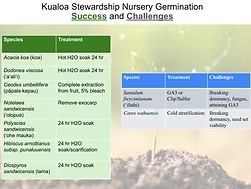
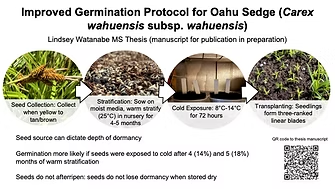
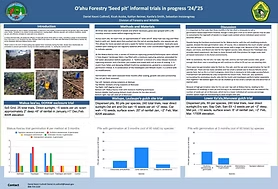
Breakout discussions centered on three restoration topics: CRB in restoration sites; nursery germination — successful methods, challenging species and trials for about 24 species; and seed-based restoration trials.
The herbicide trial activity walked groups through setting up a trial for one of nine target species, following a worksheet structured on the process presented by DOFAW-NEPM.
Click through to watch each presentation or view the slides. Questions from the audience are recorded under each session — expand any question to see the answer given on the day.
LFA Update
Erin Bishop (OISC)
Overview of Little Fire Ant status across the state and on Oʻahu, LFA biology, human–LFA interactions that facilitate invasion, and control strategies including monitoring, detection, and treatments.
What is the timeframe for eradication?
How do you treat in trees?
If your greenhouse is LFA free, how often do you recommend testing? Monthly? Is quarterly sufficient?
In a nursery, what is the spacing of sample sticks/vials?
Is there an LFA certification for nurseries?
Is there language for contracts when buying plants from nurseries?
What is the main vector?
Coqui Frog Update
Ryan Chang (DOFAW), Jessica Miura (HDOA), Robbie Snyder (OISC), Kimeona Kane (Waimānalo Lineal Descendent, Waimānalo Neighborhood Board), Taylor Campbell (Waimānalo Agriculture Association), Timo Sullivan (Aloha ʻĀina Drones)
Overview of the coqui frog invasion on Oʻahu, the history of control efforts, the Waimānalo community initiative, collaboration between OISC, DOFAW, HDOA and affected communities, and the application of innovative drone methodologies for survey and control with Aloha ʻĀina Drones.
How do you catch coqui?
Biocontrol Update
Tracy Johnson (USDA-FS)
Status of biocontrol agents under development for Natural Area weeds.
- An assortment of melastomes — Chaetogastra (previously Tibouchina), Miconia calvescens (miconia) and Miconia crenata (clidemia)
- Falcataria moluccana (albizia)
- Hedychium gardnerianum (Himalayan ginger)
- Rubus spp.
- Schinus terebinthifolius (Christmas berry)
- Chromolaena odorata (devilweed)
Hawaiʻi Drone Hui Overview
Dan Jenkins (UH Mānoa, CTAHR)
An overview of the inaugural Hawaiʻi Drone Hui meeting.
- Background — history and trends in aerial application of pesticides
- The existing (and upcoming) regulatory framework
- Innovative applications for conservation and natural resource management in Hawaiʻi
What are the challenges to using drones that were discussed at the Drone Hui meeting?
Additional questions?
Feel free to reach out to continue the conversation.
Restoration topics
Mahalo to all the programs and individuals who contributed posters to this session. Click any poster to enlarge.


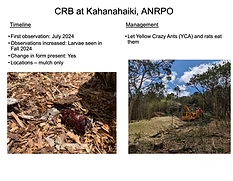

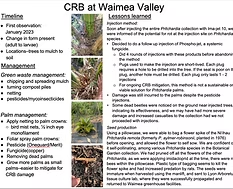
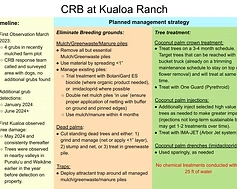
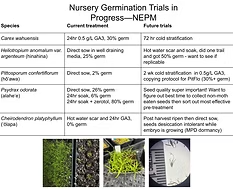
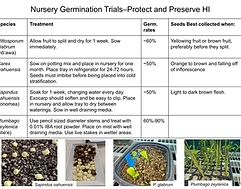
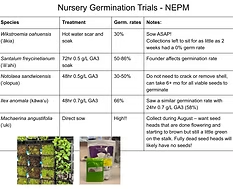
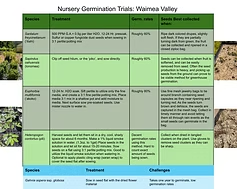
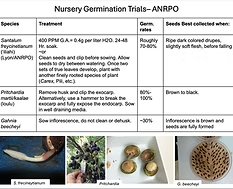
Two posters shown at the workshop are not yet in this gallery: ANRPO direct seeding (field germination) and the KMWP seed ball poster. They will be added once files are received.
This section synthesises the CRB information shared across programs. The programs represent a mix of environments spanning developed and natural areas, and manage a mix of native ecosystem restoration sites, native palm populations, or non-native palm collections. None are situated within dense urban areas, and they are often dealing with specific challenges due to access and topography.
CRB discussion
Priority ONE breakout group synthesis
Will there be testing for control methods on species other than palms?
What herbicides are you using or testing?
Have there been any trees that came back after being attacked?
Is it worthwhile to remove a standing dead tree?
Does a thick canopy hide palm species beneath?
Are there ways to systematically search the soil?
What about yellow crazy ants and CRB?
Does sun/UV deteriorate the plastic netting?
Notes on traps
What is HDOA doing?
A working summary table drawn from the nursery germination posters and discussion. This is a living resource — if you have similar or differing germination experiences, or other species you want to improve rates for, let us know.
During the discussion the group considered what other information would be useful in a table like this. Potting medium was suggested as an additional category. If there is another category you would find valuable, we want to hear it.
Germination summary
Table content to be transcribed from the poster set — structure and key confirmed at the workshop.
| Species | Inoa | Tx | Germ. | S | P |
|---|
- Inoa
- Hawaiian name
- Germ.
- Germination rate
- Tx
- Seed treatment
- ✔️
- Working method — established, generally satisfactory
- 🔄
- Trial in progress
- ⏳
- Future trial
- KR
- Kualoa Ranch
- NEPM
- DOFAW Native Ecosystems Protection and Management
- PPH
- Protect and Preserve Hawaiʻi
- ANRPO
- Army Natural Resources Program, Oʻahu
- WV
- Waimea Valley
- CTAHR
- College of Tropical Agriculture and Human Resilience — O. Baldos and L. Watanabe
Roughly 24 species were discussed. Rows are pending transcription from the poster images above.
ANRPO seed sow trials
| Species | Inoa | Time | Plots | Tx | Initial count | Final count |
|---|
- Inoa
- Hawaiian name
- Time
- Duration of trial
- Plots
- Number of plots
- Tx
- How seeds were treated before sowing
- Initial count
- Number of seedlings at first non-zero observation
- Final count
- Number of seedlings at last check
- SL
- Seed Lab
Rows pending transcription from the ANRPO direct seeding materials.
These species have information gaps in the Weed Control Matrix, and/or were indicated as species of interest through the pre-workshop survey. Each group worked through a worksheet structured around the key steps to setting up an herbicide trial.
Two different types of trial were addressed: control method (which herbicide at what application rate) and control strategy (where the herbicide is known, but other management considerations remain — return rate, pairing control with other actions, and so on).
Species addressed in breakout groups
- Rubus argutus
- Spathodea campanulata
- Ficus spp.
- Trema orientalis
- Syzygium cumini
- Cinnamomum burmannii
- Citharexylum spp.
- Megathyrsus maximus
- Cenchrus ciliaris
Take it with you
Identify the problem — species, management challenge, management goal. Research — review existing literature, use existing resources such as the Weed Control Matrix, ask around, and gather takeaways. Describe the plant — monocot or dicot, herbaceous or woody, annual or perennial, clonal. Hypothesise. Record land type, which correlates to site type on the herbicide label and informs maximum use rates. Define treatments by trial number, herbicide or cocktail, and concentration. Set monitoring protocols — frequency, duration, and metrics matched to application method.
Follow up
Our intention is that this documentation can help extend the reach of these conversations, or initiate new ones. Let us know what you are thinking, if your experience matches or diverges from what is shared here, or if you want to talk to any of these programs and practitioners in more depth.
Do you see an error — a typo, or a misrepresentation of what you shared? We want to fix it.