2025 Oʻahu Weed Control and Restoration Workshop
Priority ONE (Oʻahu Native Ecosystems) Working Group
Presentations, restoration breakout discussions, and an herbicide trial design activity — with slides, audience questions, posters, and the worksheet.
Waiʻanae Mountains Watershed Partnership · DOFAW Native Ecosystem Protection and Management · Kualoa Ranch · Army Natural Resources Program Oʻahu · Ecosystems Extension Program
- NoteOverviewOverview
This workshop was brought to you by the Priority ONE (Oʻahu Native Ecosystems) Working Group. Members of the organizing team represented the Waiʻanae Mountains Watershed Partnership, DOFAW's Native Ecosystem Protection and Management, Kualoa Ranch, the Army Na…
- NoteThe three sessionsOverview
Invited presenters gave updates about LFA on Oʻahu (OISC), coqui frog on Oʻahu (DOFAW and partners), biocontrol development for Natural Area weeds (USDA-FS), and an overview of the inaugural meeting of the Hawaiʻi Drone Hui. Breakout discussions centered on th…
- NotePresentationsPresentations
Click through to watch each presentation or view the slides. Questions from the audience are recorded under each session — expand any question to see the answer given on the day.
- SessionLFA UpdatePresentations
Overview of Little Fire Ant status across the state and on Oʻahu, LFA biology, human–LFA interactions that facilitate invasion, and control strategies including monitoring, detection, and treatments.
- QuestionWhat is the timeframe for eradication?Presentations
Treatments every 6 weeks, for 12 months.
- QuestionHow do you treat in trees?Presentations
Toxicant (granular) on the ground, spray growth inhibitor (liquid) in trees.
- QuestionIf your greenhouse is LFA free, how often do you recommend testing? Monthly? Is quarterly sufficient?Presentations
Testing quarterly is sufficient. If you are LFA free you can even test annually.
- QuestionIn a nursery, what is the spacing of sample sticks/vials?Presentations
Every 10 steps.
- QuestionIs there an LFA certification for nurseries?Presentations
No.
- QuestionIs there language for contracts when buying plants from nurseries?Presentations
Yes — reach out to OISC for language and SOPs that will ensure folks test for LFA, or have OISC check your existing language.
- QuestionWhat is the main vector?Presentations
Plants and landscaping. Large landscaping projects can spread ants very quickly. Not all nurseries have LFA, but those with detections are working with HDOA. A nursery having no past detection does NOT mean it is LFA free — consistent testing is needed to be c…
- DownloadLFA Update — slidesPresentations
- SessionCoqui Frog UpdatePresentations
Overview of the coqui frog invasion on Oʻahu, the history of control efforts, the Waimānalo community initiative, collaboration between OISC, DOFAW, HDOA and affected communities, and the application of innovative drone methodologies for survey and control wit…
- QuestionHow do you catch coqui?Presentations
With a long tube. Listen for the frog, position the tube opening in front of it and the frog will jump in. Tubes are getting harder to find as fluorescent lights are phased out. We also need plastic bottles to store caught frogs — give us your Gatorade bottles…
- DownloadCoqui Frog Update — slidesPresentations
- SessionBiocontrol UpdatePresentations
Status of biocontrol agents under development for Natural Area weeds.
- SessionHawaiʻi Drone Hui OverviewPresentations
An overview of the inaugural Hawaiʻi Drone Hui meeting.
- QuestionWhat are the challenges to using drones that were discussed at the Drone Hui meeting?Presentations
Regulations that limit flights to line of sight; interaction with piloted aviation; operating at night — automated flights have proven a good workaround, and if you can fly in daytime you can fly at night; some targets are easier than others, with low-to-the-g…
- DownloadHawaiʻi Drone Hui Overview — slidesPresentations
- ContactEcosystemsExtensionHI@gmail.comPresentations
Additional questions?
- PosterWahiawā Botanical Garden — CRBPoster gallery
- PosterHoʻomaluhia Botanical Garden — CRBPoster gallery
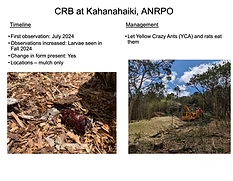
- PosterʻŌhikilolo, ANRPO — CRBPoster gallery
- PosterANRPO — KikiPoster gallery
- PosterBWS Mākaha Valley — CRBPoster gallery
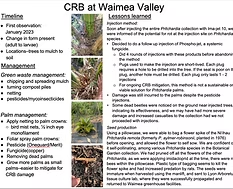
- PosterWaimea ValleyPoster gallery
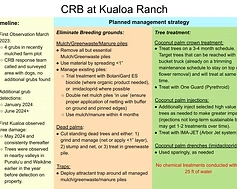
- PosterKualoa Ranch — CRBPoster gallery
- PosterDOFAW-NEPM — trials in progressPoster gallery
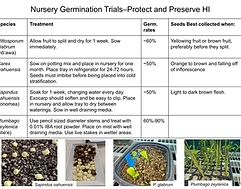
- PosterProtect and Preserve Hawaiʻi — trialsPoster gallery
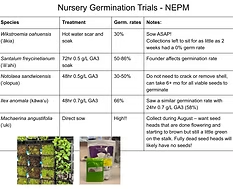
- PosterDOFAW-NEPM — trialsPoster gallery
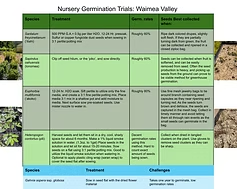
- PosterWaimea Valley — trialsPoster gallery
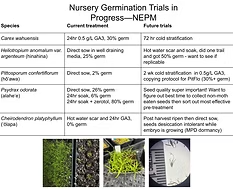
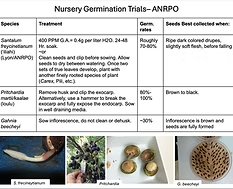
- PosterANRPO — nursery germinationPoster gallery
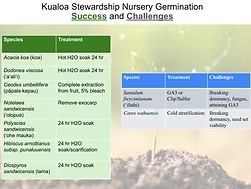
- PosterKualoa — nursery germinationPoster gallery
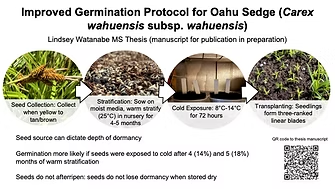
- PosterCarex germinationPoster gallery
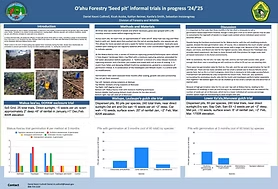
- PosterSeed pitsPoster gallery
- NoteNot yet digitisedPoster gallery
Two posters shown at the workshop are not yet in this gallery: ANRPO direct seeding (field germination) and the KMWP seed ball poster. They will be added once files are received.
- NoteCRB in restorationCRB in restoration
This section synthesises the CRB information shared across programs. The programs represent a mix of environments spanning developed and natural areas, and manage a mix of native ecosystem restoration sites, native palm populations, or non-native palm collecti…
- SessionCRB discussionCRB in restoration
- QuestionWill there be testing for control methods on species other than palms?CRB in restoration
Not too many other preferred species (banana, hala, etc.) are available at the gardens, but we might explore control methods on kalo next. There are a lot of collections in the gardens.
- QuestionWhat herbicides are you using or testing?CRB in restoration
Merit is a granular product, but probably not a long-term solution. Drenching takes too long and is not feasible. Crown injection also consumes staff time. There is money to fund a full-time team of two for four months performing crown injections on coconut.
- QuestionHave there been any trees that came back after being attacked?CRB in restoration
No rares have come back, but one at Hoʻomaluhia regrew after being eaten by CRB.
- QuestionIs it worthwhile to remove a standing dead tree?CRB in restoration
These are often lowest priority for removal at the gardens and could take 4–5 months. It may be worth landowners doing it themselves by netting the trunk, with the goal of the slowest decay. Cutting and chipping might get everything already in the pile but wou…
- QuestionDoes a thick canopy hide palm species beneath?CRB in restoration
CRB tend to fly high and mostly hit taller trees. At first the decision was to halt planting more loulu at the gardens, but that will be reconsidered. Decoy trees might be a good distraction.
- QuestionAre there ways to systematically search the soil?CRB in restoration
No — we usually find them while outplanting, and through moving soil around we find grubs.
- QuestionWhat about yellow crazy ants and CRB?CRB in restoration
Yellow crazy ants are possibly preying on CRB, though it is unclear whether they are deliberately going after them or finding them as food after the fact.
- QuestionDoes sun/UV deteriorate the plastic netting?CRB in restoration
Yes. Deteriorating netting creates large piles of nets with holes and eventually microplastics. There are two types on the market to consider: polypropylene and high density polyethylene.
- QuestionNotes on trapsCRB in restoration
Only pheromone traps are in use in Mākaha, and more are found all the time. The Army Natural Resources Program has set up breeding site traps, but nothing has been caught in them yet.
- QuestionWhat is HDOA doing?CRB in restoration
HDOA is currently making guidelines on how to manage CRB and guiding requirements for laws. One suggestion was that they also include verbiage on proper disposal of netting materials.
- NoteNursery germinationNursery germination
A working summary table drawn from the nursery germination posters and discussion. This is a living resource — if you have similar or differing germination experiences, or other species you want to improve rates for, let us know. During the discussion the grou…
- NoteHerbicide trial activityHerbicide trial activity
These species have information gaps in the Weed Control Matrix, and/or were indicated as species of interest through the pre-workshop survey. Each group worked through a worksheet structured around the key steps to setting up an herbicide trial. Two different…
- SpeciesRubus argutusHerbicide trial activity
- SpeciesSpathodea campanulataHerbicide trial activity
- SpeciesFicus spp.Herbicide trial activity
- SpeciesTrema orientalisHerbicide trial activity
- SpeciesSyzygium cuminiHerbicide trial activity
- SpeciesCinnamomum burmanniiHerbicide trial activity
- SpeciesCitharexylum spp.Herbicide trial activity
- SpeciesMegathyrsus maximusHerbicide trial activity
- SpeciesCenchrus ciliarisHerbicide trial activity
- DownloadStapelia gigantea herbicide trials — DOFAW-NEPM worked exampleHerbicide trial activity
- DownloadHerbicide trial worksheet (editable)Herbicide trial activity
- NoteThe worksheet stepsHerbicide trial activity
Identify the problem — species, management challenge, management goal. Research — review existing literature, use existing resources such as the Weed Control Matrix, ask around, and gather takeaways. Describe the plant — monocot or dicot, herbaceous or woody,…
- ContactEcosystemsExtensionHI@gmail.comFollow up
Follow up
- Contactlportner@hawaii.eduFollow up
Follow up